

Audio technology Sonos company (NASDAQ:SONO) reported Q1 CY2026 results beating Wall Street’s revenue expectations, with sales up 8.4% year on year to $281.5 million. Its non-GAAP loss of $0.02 per share was $0.03 below analysts’ consensus estimates.
Is now the time to buy Sonos? Find out by accessing our full research report, it’s free.
Sonos (SONO) Q1 CY2026 Highlights:
- Revenue: $281.5 million vs analyst estimates of $266.8 million (8.4% year-on-year growth, 5.5% beat)
- Adjusted EPS: -$0.02 vs analyst estimates of $0.01 ($0.03 miss)
- Adjusted EBITDA: $1.72 million (0.6% margin, 308% year-on-year growth)
- Operating Margin: -11.2%, up from -23.6% in the same quarter last year
- Free Cash Flow was -$70.15 million compared to -$65.22 million in the same quarter last year
- Market Capitalization: $1.79 billion
“The first half of Fiscal 2026 marks an important turning point for Sonos as we return to growth and change the trajectory of the business,” said Tom Conrad, Chief Executive Officer of Sonos.
Company Overview
A pioneer in connected home audio systems, Sonos (NASDAQ:SONO) offers a range of premium wireless speakers and sound systems.
Revenue Growth
A company’s long-term sales performance is one signal of its overall quality. Any business can have short-term success, but a top-tier one grows for years. Over the last five years, Sonos’s demand was weak and its revenue declined by 1.4% per year. This was below our standards and suggests it’s a low quality business.
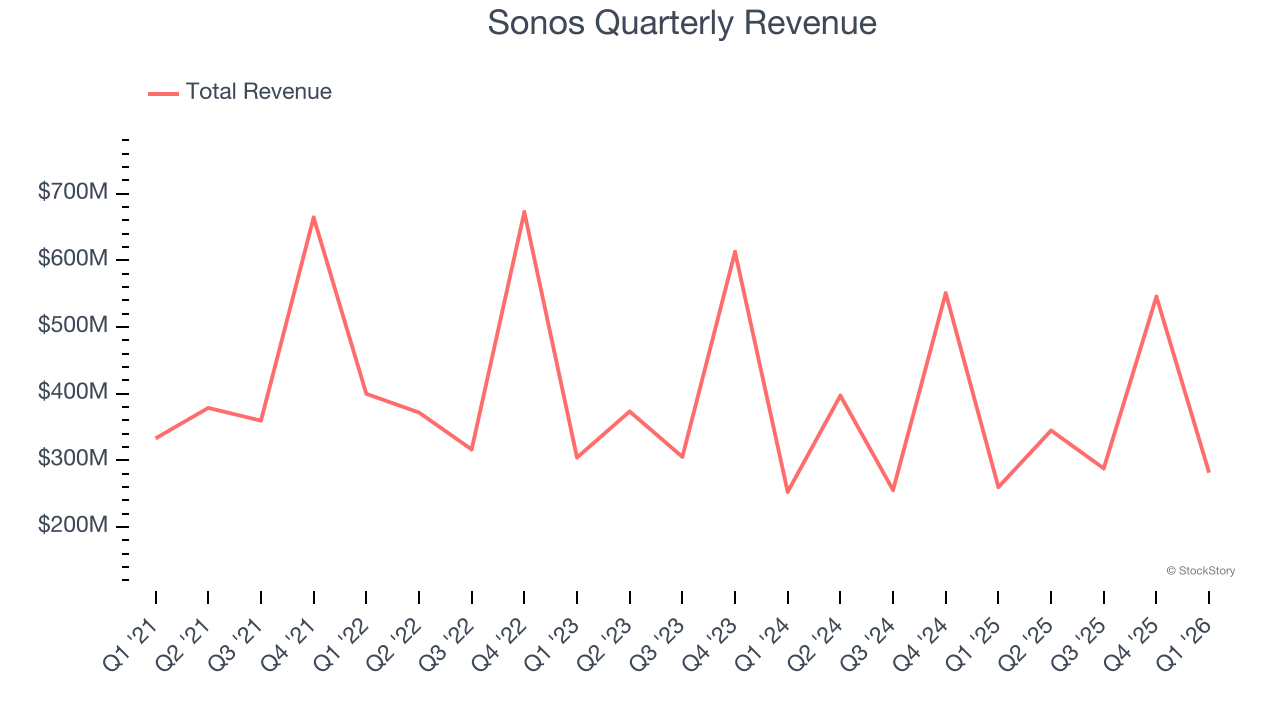
We at StockStory place the most emphasis on long-term growth, but within consumer discretionary, a stretched historical view may miss a company riding a successful new product or trend. Sonos’s recent performance shows its demand remained suppressed as its revenue has declined by 2.8% annually over the last two years. 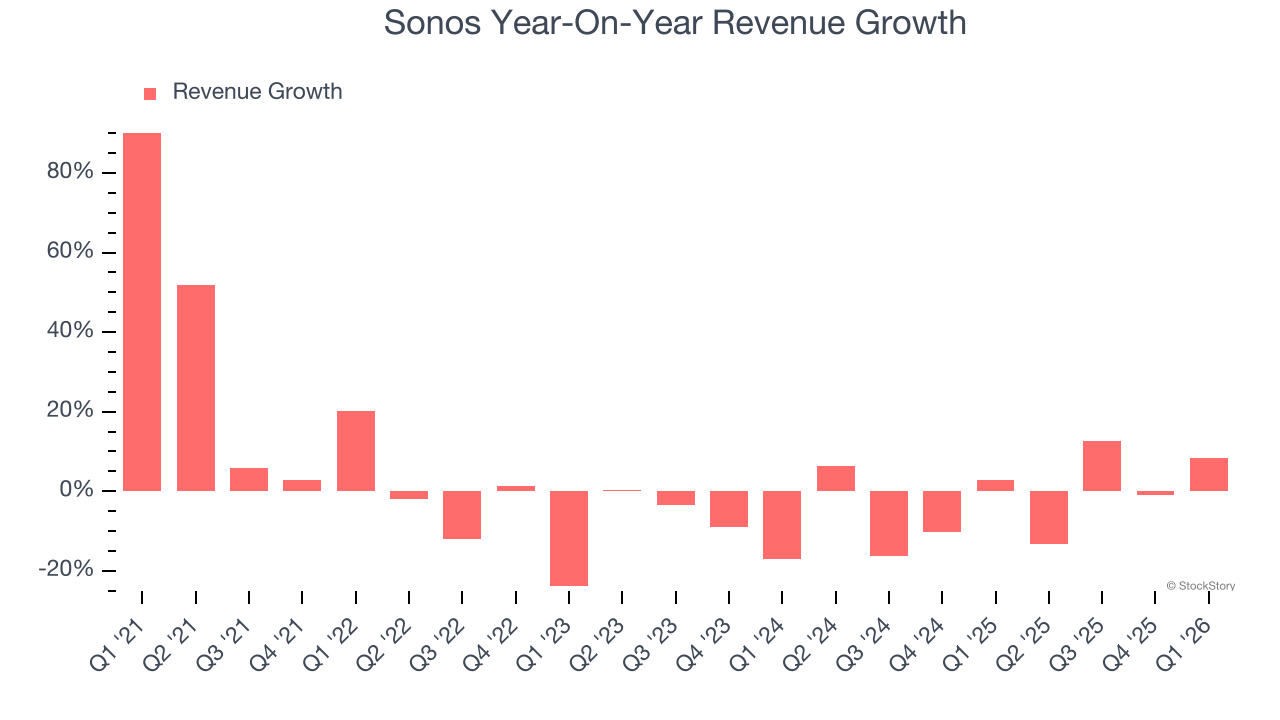
This quarter, Sonos reported year-on-year revenue growth of 8.4%, and its $281.5 million of revenue exceeded Wall Street’s estimates by 5.5%.
Looking ahead, sell-side analysts expect revenue to grow 5.3% over the next 12 months. Although this projection implies its newer products and services will fuel better top-line performance, it is still below average for the sector.
ONE MORE THING: 3 Hidden Platforms Growing 3X Faster than Amazon, Google, and PayPal. Amazon, Google, and Meta all followed the same playbook: Dominate an ignored market. Build an unbeatable moat. Scale until you’re unstoppable.
These three platforms are running that exact playbook right now. The early investors in Amazon made fortunes. The early investors in these could do the same. Get All 3 Stocks Here for FREE.
Operating Margin
Operating margin is an important measure of profitability as it shows the portion of revenue left after accounting for all core expenses – everything from the cost of goods sold to advertising and wages. It’s also useful for comparing profitability across companies with different levels of debt and tax rates because it excludes interest and taxes.
Sonos’s operating margin has risen over the last 12 months, but it still averaged negative 1.3% over the last two years. This is due to its large expense base and inefficient cost structure.
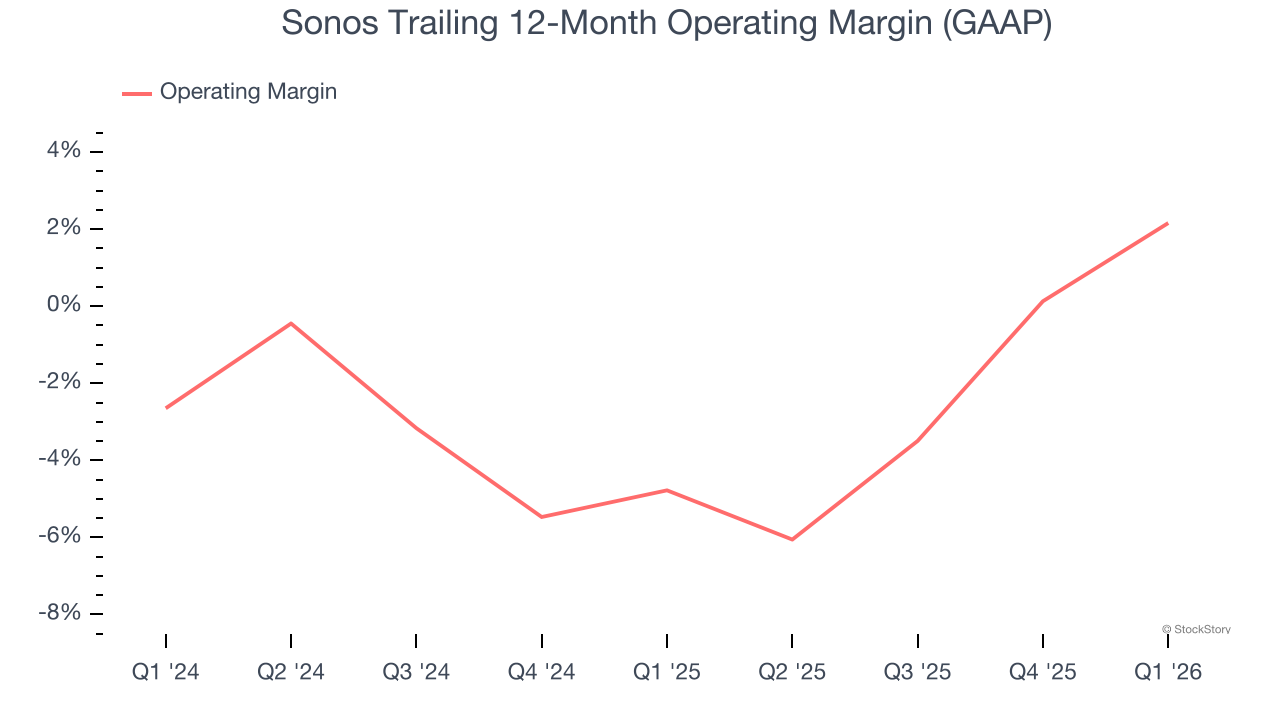
This quarter, Sonos generated a negative 11.2% operating margin. The company's consistent lack of profits raise a flag.
Earnings Per Share
Revenue trends explain a company’s historical growth, but the long-term change in earnings per share (EPS) points to the profitability of that growth – for example, a company could inflate its sales through excessive spending on advertising and promotions.
Sadly for Sonos, its EPS declined by 9.3% annually over the last five years, more than its revenue. This tells us the company struggled because its fixed cost base made it difficult to adjust to shrinking demand.
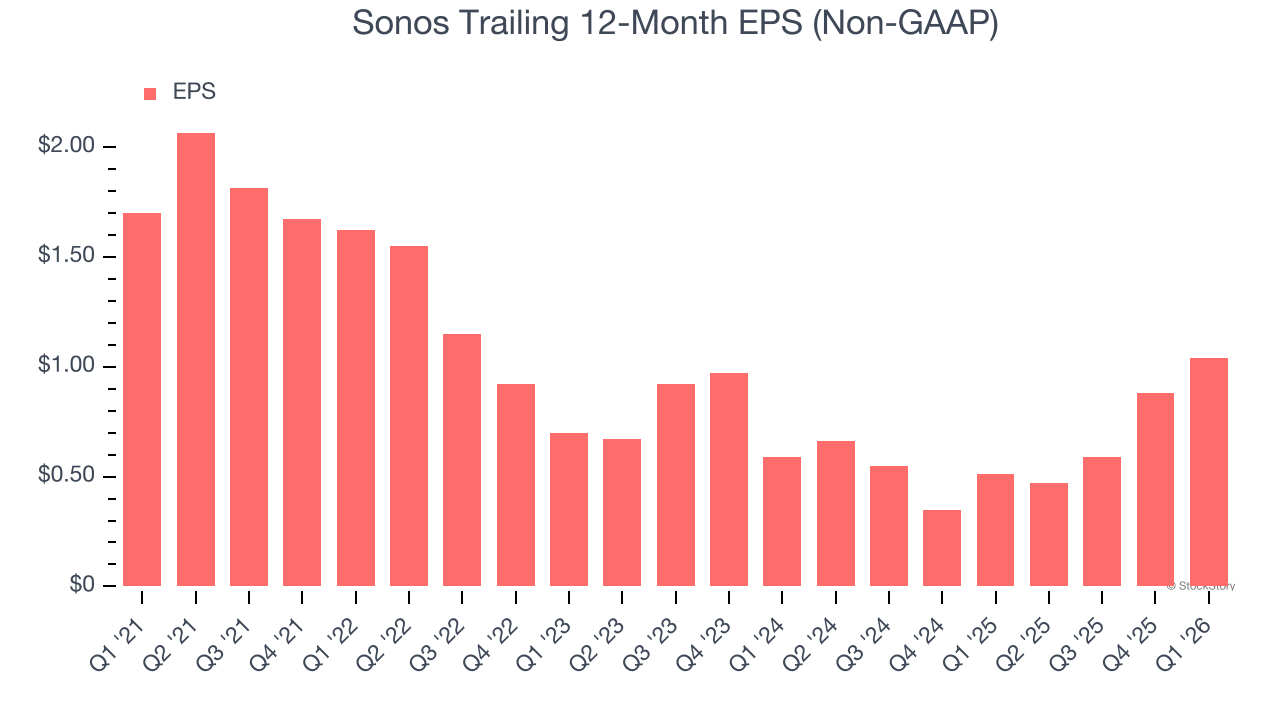
In Q1, Sonos reported adjusted EPS of negative $0.02, up from negative $0.18 in the same quarter last year. Despite growing year on year, this print missed analysts’ estimates. We also like to analyze expected EPS growth based on Wall Street analysts’ consensus projections, but there is insufficient data.
Key Takeaways from Sonos’s Q1 Results
We were impressed by how significantly Sonos blew past analysts’ EBITDA expectations this quarter. We were also glad its revenue outperformed Wall Street’s estimates. On the other hand, its adjusted operating income missed and its EPS was in line with Wall Street’s estimates. Overall, this was a softer quarter. The stock traded up 4.8% to $15.58 immediately following the results.
Should you buy the stock or not? When making that decision, it’s important to consider its valuation, business qualities, as well as what has happened in the latest quarter. We cover that in our actionable full research report which you can read here (it’s free).